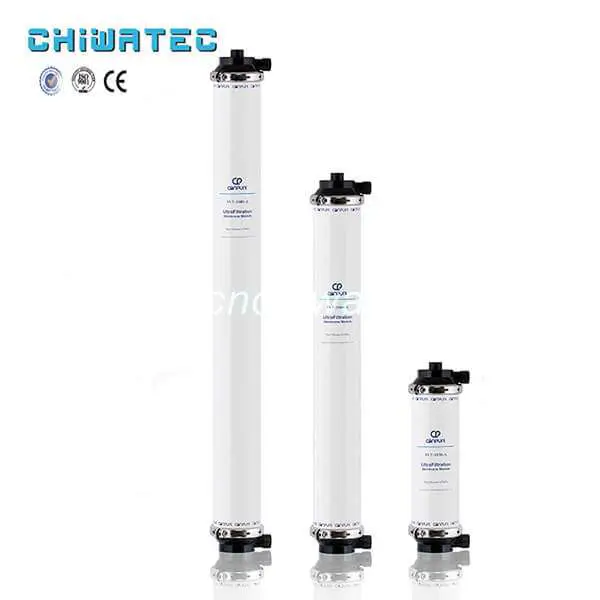
Ultrafiltration Membrane Applications in Water Treatment: Complete Pretreatment Guide 2026
Ultrafiltration membrane technology serves as both pretreatment and advanced treatment in water purification, industrial concentration, and separation processes. This comprehensive guide covers pretreatment requirements, contamination control, SDI management, and 2026 best practices for maximizing UF membrane performance and service life.
Role of Ultrafiltration in Water Treatment Systems
Dual-Function Application
Ultrafiltration technology operates in two primary capacities:
- Pretreatment Stage: UF serves as pretreatment for reverse osmosis (RO), nanofiltration (NF), and other sensitive membrane processes, removing particles, colloids, bacteria, and viruses that could foul downstream equipment
- Advanced Treatment Stage: UF functions as deep purification in municipal drinking water, industrial process water, and wastewater recycling applications
According to 2025 industry data, UF pretreatment reduces RO membrane fouling by 70-85%, extending RO membrane life from 3-5 years to 7-10 years while reducing chemical cleaning frequency by 60%.
UF Membrane Pretreatment Requirements
Why Pretreatment is Critical
Hollow fiber ultrafiltration membranes have specific feedwater requirements. Without proper pretreatment, several contamination mechanisms occur:
- Surface Fouling: Suspended solids, colloids, and microorganisms adhere to the membrane surface
- Concentration Polarization: Due to UF’s relatively high water flux, trapped impurities concentrate rapidly on the membrane surface, creating osmotic pressure resistance
- Pore Blocking: Very small particles enter and block membrane pores, permanently reducing permeability
- Biofouling: Microorganisms and their metabolic byproducts (EPS – extracellular polymeric substances) form viscous biofilms on membrane surfaces
These factors lead to decreased water permeability, altered separation performance, increased transmembrane pressure (TMP), and higher energy consumption. Proper pretreatment extends membrane service life from 2-3 years to 5-7 years and reduces operating costs by 40-50%.
Feedwater Parameter Limits
| Parámetro | Acceptable Range | Critical Limit |
|---|---|---|
| La temperatura | 5-35°C | Max 45°C (PVDF), 40°C (PES) |
| pH | 6.5-8.5 | 2-11 (cleaning), 3-10 (operation) |
| Turbiedad | <5 NTU | <10 NTU (with coagulation) |
| SDI₁₅ | <3 | <5 (acceptable) |
| Free Chlorine | 0.5-1.0 mg/L | Max 200 mg/L (PVDF) |
Microorganism Control (Bacteria, Algae)
Impact of Microorganisms on UF Membranes
Microorganisms pose extreme risks to hollow fiber ultrafiltration membranes:
- Microorganisms trapped in pretreatment systems (e.g., multi-media filter media surfaces) can adhere and proliferate
- When microorganisms attach to UF membrane surfaces, they grow and reproduce, potentially completely blocking micropores or even the entire hollow fiber lumen
- Biofilm formation creates irreversible fouling that requires aggressive chemical cleaning
- Microbial metabolites (proteins, polysaccharides) increase membrane hydrophobicity and fouling propensity
Disinfection Methods
1. Chemical Oxidation:
- Sodium Hypochlorite (NaClO): Most common oxidant, dosage 1-5 mg/L as Cl₂
- Ozone (O₃): Stronger oxidant, dosage 0.5-2 mg/L, no residual byproducts
- Chlorine Dioxide (ClO₂): Effective against Cryptosporidium, dosage 0.5-1 mg/L
2. UV Sterilization:
- Dose: 30-40 mJ/cm² for 99.9% bacteria/virus inactivation
- No chemical residuals, but no disinfection residual for distribution
- Often combined with low-dose chlorination for residual protection
3. Membrane Module Sterilization (Laboratory/Offline):
- Hydrogen Peroxide (H₂O₂): 3% solution, 30-60 minutes contact time
- Potassium Permanganate (KMnO₄): 10-50 ppm solution, 30-60 minutes
- Sodium Hypochlorite: 100-200 ppm for severe biofouling
Important Note: Antimicrobial treatment kills microorganisms but does not remove them from water. Dead cells and cell fragments still contribute to fouling. Therefore, disinfection should be followed by filtration to remove inactivated microorganisms.
Turbidity Reduction and SDI Control
Understanding Turbidity
Turbidity measures water’s light-scattering properties caused by suspended particles. Key characteristics:
- Measurement: 1 mg/L SiO₂ produces 1 degree of turbidity (nephelometric turbidity units, NTU)
- Factors: Particle quantity, size, shape, color, and opacity all affect measurement
- Standards: General domestic water ≤5 NTU; Drinking water ≤1 NTU; UF feedwater ≤5 NTU (ideally ≤1 NTU)
- Limitation: Turbidity cannot accurately reflect particles smaller than a few microns
SDI (Silt Density Index) Testing
SDI is the industry-standard method for predicting raw water fouling tendency in membrane systems:
Test Method:
- Use 0.45 μm microporous filter membrane
- Apply constant pressure of 0.21 MPa (30 psi)
- Record time t₀ to filter initial 500 mL
- Continue filtration for 15 minutes
- Record time t₁₅ to filter another 500 mL
- Calculate: SDI₁₅ = (1 – t₀/t₁₅) × 100 / 15
SDI Interpretation:
- SDI < 3: Excellent (typical of well water, RO feedwater requirement)
- SDI 3-5: Acceptable (requires monitoring)
- SDI > 5: Poor (pretreatment required; typical of surface water)
- SDI > 6.66: Unacceptable (test invalid; severe fouling risk)
UF Performance on SDI Reduction
Ultrafiltration is the most effective technology for SDI reduction:
- UF Effluent SDI: Consistently <1, often approaching 0
- RO Protection: UF pretreatment ensures RO feedwater SDI <3, meeting manufacturer warranties
- High SDI Feedwater: When raw water SDI is too high (especially with large particles), UF membranes themselves require pretreatment
Pretreatment Technologies for UF Systems
Conventional Pretreatment
1. Media Filtration:
- Quartz Sand Filters: Remove suspended solids >20-50 μm
- Multi-Media Filters: Anthracite + sand + garnet layers for graded filtration
- Activated Carbon Filters: Remove organic matter, chlorine, taste/odor compounds
2. Coagulation-Flocculation:
- Coagulants: Aluminum sulfate (alum), ferric chloride, polyaluminum chloride (PAC)
- Flocculants: Polyacrylamide (PAM) for enhanced particle aggregation
- Application: Essential for high-turbidity surface water (turbidity >50 NTU)
3. Sedimentation/Clarification:
- Plate Settlers: High-rate clarification for large particles
- Dissolved Air Flotation (DAF): Effective for algae, oils, low-density particles
Advanced Pretreatment (2026 Trends)
- Microfiltration (MF) Pretreatment: MF before UF for extremely challenging feedwaters
- Ceramic Membrane Pretreatment: For high-temperature or aggressive chemical environments
- Electrocoagulation: Chemical-free coagulation using electric current
- Green Pretreatment: Bio-based coagulants (chitosan, Moringa oleifera) for sustainable operations
Pretreatment Process Selection
There is no fixed pretreatment mode—selection depends on source water characteristics:
Groundwater (Well Water)
- Typical Quality: Low turbidity (<5 NTU), SDI <3, minimal organics
- Pretreatment: Often minimal—cartridge filtration (5-10 μm) + disinfection
- Special Considerations: Iron/manganese removal if present; hardness management
Surface Water (River, Lake, Reservoir)
- Typical Quality: Variable turbidity (10-500+ NTU), SDI >5, seasonal algae blooms
- Pretreatment: Coagulation-flocculation + sedimentation/DAF + media filtration + disinfection
- Special Considerations: Seasonal variation management; storm event response
Municipal Wastewater (Reclamation)
- Typical Quality: High organics, nutrients, suspended solids
- Pretreatment: Biological treatment (activated sludge/MBR) + tertiary filtration + disinfection
- Special Considerations: Pharmaceutical/personal care product (PPCP) removal; nutrient management
Seawater (Desalination Pretreatment)
- Typical Quality: High salinity, suspended solids, marine organisms
- Pretreatment: Intake screening + coagulation + DAF or media filtration + disinfection
- Special Considerations: Biofouling control; algal bloom management
2026 Industry Best Practices
Monitoring and Control
- Real-time SDI Monitoring: Automated SDI analyzers for continuous feedwater quality assessment
- Particle Counting: Laser particle counters for sub-micron particle detection
- ATP Testing: Adenosine triphosphate testing for rapid microbial activity assessment
- Smart Dosing: AI-controlled coagulant/disinfectant dosing based on real-time water quality
Sustainability Initiatives
- Chemical Minimization: Optimized coagulant dosing reduces chemical consumption by 30-50%
- Backwash Water Recovery: 90-95% recovery through settling and filtration
- Energy Efficiency: Variable frequency drives (VFD) on feed pumps reduce energy by 20-30%
- Carbon Footprint: Lifecycle assessment for pretreatment chemical selection
Conclusión
Proper pretreatment is the foundation of successful ultrafiltration membrane operation. By understanding feedwater characteristics, implementing appropriate pretreatment technologies, and maintaining rigorous monitoring protocols, water treatment facilities can maximize UF membrane performance, extend service life to 5-7 years, and minimize operating costs. As 2026 industry standards continue to evolve, smart monitoring and sustainable pretreatment practices will become increasingly critical for achieving optimal water treatment outcomes.
Xi’an CHIWATEC Water Treatment Technology is a high-tech enterprise specialized in various water processing devices. We provide comprehensive engineering solutions including designing, machining, installing, commissioning, and customization services. As one of the fastest-developing water treatment equipment manufacturers in Western China, we are committed to delivering innovative and sustainable water treatment solutions.
Further Reading
- Ultrafiltration Membrane Process: Operating Parameters Guide
- Ultrafiltration Membrane Cleaning Methods and Procedures
- Ultrafiltration Technology: Complete Introduction
- Hollow Fiber Ultrafiltration Membrane Guide
¿Tiene un proyecto de tratamiento de agua con el que podamos ayudar?
* Diseño, mecanizado, instalación, puesta en marcha, personalización y servicio integral
 Spanish
  English
  Portuguese