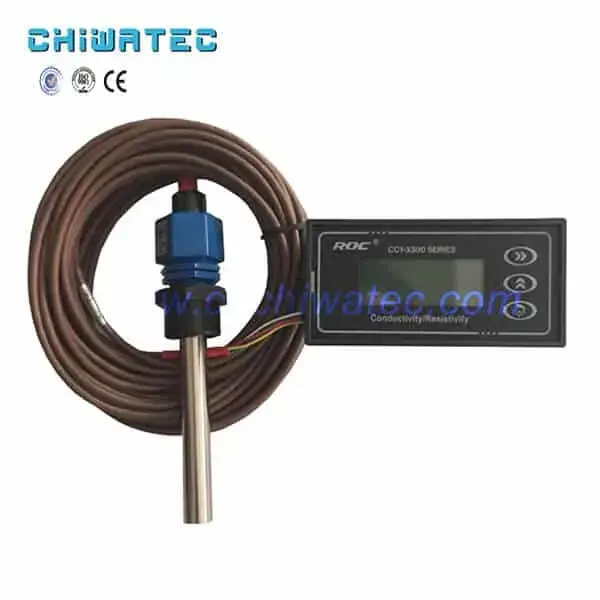
Softened Water Treatment Equipment in Boiler Industry: Complete 2026 Guide
Equipos de tratamiento de agua ablandada plays a critical role in the industria de la caldera, preventing scale formation and corrosion that can lead to equipment failure and safety hazards. A qualified boiler water treatment system must effectively provide both scale inhibition y corrosion inhibition—protecting not only the boiler body but also steam pipes, heat exchangers, and condensate return lines. This comprehensive guide examines softened water treatment equipment applications in boiler systems, addressing water quality challenges, treatment technologies, and industry best practices for 2026.
According to 2025 industry data, the global industrial boiler water treatment market reached $8.4 billion, with water softening systems accounting for 62% of installations. Proper boiler feedwater treatment reduces energy consumption by 12-18% and extends boiler lifespan by 5-10 years compared to untreated systems.
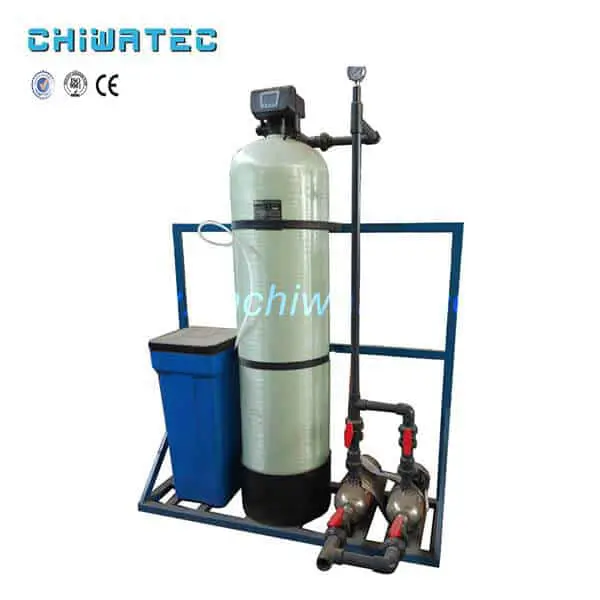
Why Water Treatment is Critical for Boiler Systems
Boiler systems face two primary threats from untreated or inadequately treated water: scale formation y corrosion. Understanding these mechanisms is fundamental to selecting appropriate equipo de tratamiento de agua.
Scale Formation Mechanisms
Calcium (Ca²⁺) and Magnesium (Mg²⁺) ions are the primary fouling ions responsible for boiler scale. Most modern boilers employ ion exchange water softeners to remove these hardness ions before feedwater enters the boiler system. However, scale formation remains a significant challenge:
- Concentration Effects: As boiler water evaporates and concentrates, dissolved salt concentrations increase beyond solubility limits
- High-Temperature Zones: In smoke tubes and other high-temperature areas, rapid water vaporization causes localized salt crystallization
- Residual Hardness: Even softened water may contain trace hardness that accumulates over time
This explains why many boilers using softened water still experience fouling. While increasing blowdown (pollutant discharge) can alleviate scaling, this approach has significant drawbacks:
- Energy Waste: Excessive blowdown wastes heated water and treatment chemicals
- Alkalinity Loss: Increased blowdown often reduces boiler water alkalinity below national standard minimums
- Accelerated Corrosion: Low alkalinity conditions accelerate corrosion rates, creating a vicious cycle
Therefore, implementing appropriate anti-scale measures for boiler water remains essential even with ion exchange pretreatment.
Corrosion Mechanisms in Boiler Systems
Corrosion inhibition must protect multiple system components: boiler body, steam pipes, heat exchangers, and condensate return lines. Three primary factors drive boiler corrosion:
Dissolved Oxygen: The Primary Corrosion Factor
Dissolved oxygen in water represents the main factor causing boiler corrosion. At elevated boiler temperatures, dissolved oxygen reacts rapidly with iron, forming iron oxides and accelerating metal degradation.
Chemical Deaeration Requirements:
- Boilers Without Deaerators: Chemical deaeration measures are absolutely indispensable
- Boilers With Deaerators: Current thermal deaerators cannot completely remove oxygen, especially during startup
- Intermittent Operation: For non-continuously operating boilers, thermal deaerators prove nearly ineffective during initial startup phases
Chemical oxygen scavengers (such as sodium sulfite or hydrazine alternatives) provide essential backup protection, ensuring dissolved oxygen levels remain below 0.007 mg/L as per industry standards.
Iron Contamination (Fe³⁺) and Corrosion Acceleration
Trivalent iron (Fe³⁺) represents another major corrosion factor, particularly in closed heating systems common in office buildings, hotels, and commercial facilities.
Condensate Return Challenges:
- Closed heating systems typically achieve 80% condensate reuse as boiler makeup water
- Without proper corrosion inhibition in steam pipes, condensate lines, and heat exchangers, iron dissolves into condensate
- Fe³⁺ possesses strong oxidizing properties, dramatically accelerating boiler corrosion rates
- This creates a self-perpetuating cycle: corrosion releases iron, which accelerates further corrosion
Proper corrosion inhibitor dosing in condensate return systems breaks this cycle, protecting both distribution infrastructure and boiler equipment.
Carbon Dioxide (CO₂) and Condensate Corrosion
Carbon dioxide in boiler feedwater creates acidic conditions that severely accelerate corrosion in condensate systems.
CO₂ Corrosion Mechanism:
- CO₂ enters boiler with feedwater
- Heat causes CO₂ to escape from water, traveling with steam into heat exchangers
- CO₂ re-dissolves in condensate, forming carbonic acid (H₂CO₃)
- Acidic conditions (pH <7) dramatically accelerate iron corrosion
- Large amounts of iron dissolve into condensate
- Severe cases require condensate disposal, wasting energy and water
Condensate Polishing: Installing condensate polishers or dosing filming amines y neutralizing amines protects condensate return systems from CO₂ corrosion, enabling safe condensate reuse and energy recovery.
Ion Exchange Water Softening for Boilers
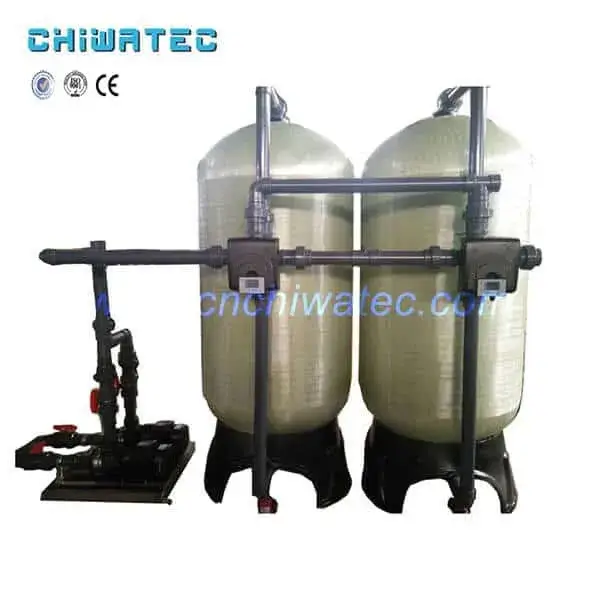
Ion exchange water softening remains the cornerstone of boiler feedwater treatment, removing hardness ions that cause scale formation.
How Ion Exchange Softeners Work
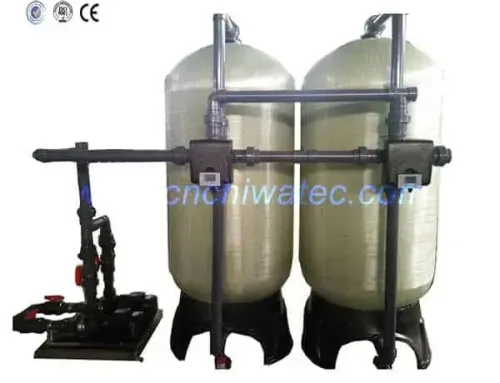
Sodium ion exchange resins replace calcium and magnesium ions with sodium ions through reversible chemical reactions:
2R-Na + Ca²⁺ → R₂-Ca + 2Na⁺
Where R represents the resin matrix. This exchange prevents calcium carbonate and calcium sulfate scale formation in boiler systems.
Softener Selection Criteria for Boilers:
- Capacidad: Size based on boiler makeup water requirements and raw water hardness
- Control Type: Time-clock or demand-initiated regeneration (DIR) based on usage patterns
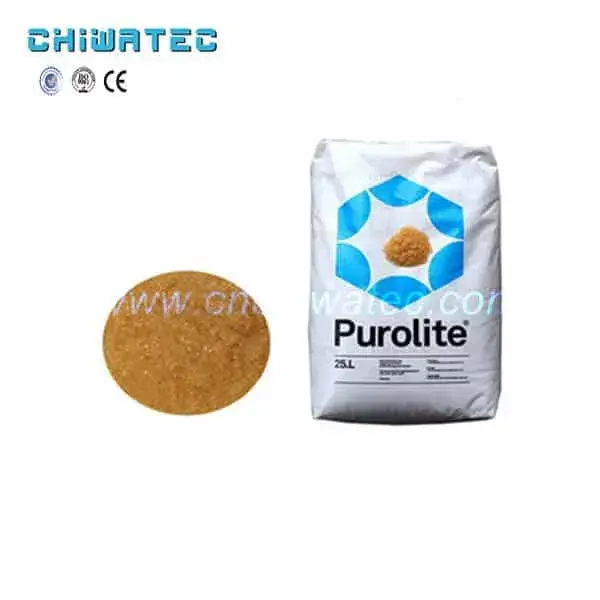
- Resin Type: Strong acid cation (SAC) resin for standard applications
- Outlet Hardness: Must achieve <0.03 mmol/L to meet GB1576 boiler water quality standards
Limitations of Ion Exchange Softening
While ion exchange softeners effectively remove hardness, they do not address:
- Dissolved Oxygen: Requires separate deaeration or chemical scavenging
- Alkalinity: Softening does not reduce bicarbonate alkalinity, which decomposes to CO₂ in boilers
- Total Dissolved Solids (TDS): Softening actually increases TDS slightly due to sodium addition
- Silica: Requires reverse osmosis or demineralization for removal
Comprehensive boiler water treatment requires multiple treatment stages beyond softening alone.
Complete Boiler Water Treatment System Components
Effective boiler water treatment requires integrated systems addressing all water quality parameters.
Multi-Stage Treatment Approach
Stage 1: Pretreatment
- Multimedia filtration for suspended solids removal
- Activated carbon filtration for chlorine and organic removal
- Water softening for hardness removal
Stage 2: Deaeration
- Thermal deaerators for bulk oxygen removal
- Vacuum deaerators for low-pressure applications
- Chemical oxygen scavengers for polishing
Stage 3: Internal Treatment
- Phosphate programs for residual hardness sequestration
- Alkalinity builders for pH control
- Dispersants for sludge conditioning
- Corrosion inhibitors for metal protection
Stage 4: Condensate Treatment
- Filming amines for pipe surface protection
- Neutralizing amines for pH elevation
- Condensate polishers for iron removal
2026 Industry Trends and Regulatory Updates
los boiler water treatment industry continues evolving with enhanced efficiency standards and environmental regulations:
- Phosphate-Free Programs: 2025 EU regulations restrict phosphate discharge, driving adoption of polymeric alternatives
- Smart Monitoring: IoT-enabled systems with real-time water quality monitoring and automated chemical dosing
- High-Efficiency Softeners: Next-generation resins with 20% higher exchange capacity and reduced salt consumption
- Zero Liquid Discharge (ZLD): Increasing adoption in water-scarce regions, requiring advanced treatment trains
- Energy Recovery: Enhanced condensate return systems capturing 90%+ of latent heat
Industry analysts project 7.8% CAGR for industrial boiler water treatment through 2030, driven by efficiency mandates and sustainability initiatives.
Conclusión
Equipos de tratamiento de agua ablandada forms the foundation of effective boiler water management, but comprehensive protection requires addressing multiple water quality parameters. While ion exchange softeners effectively remove hardness ions (Ca²⁺ and Mg²⁺), preventing scale formation, additional treatment stages are essential for controlling dissolved oxygen, iron contamination, and CO₂ corrosion.
Modern boiler industry water treatment demands integrated approaches combining ablandamiento del agua, deaeration, chemical treatment, and condensate polishing. Understanding these interconnected mechanisms enables facility managers and engineers to specify appropriate equipo de tratamiento de agua that maximizes boiler efficiency, extends equipment lifespan, and ensures safe, reliable operation.
As boiler water treatment technology advances with smart monitoring and environmentally friendly chemistries, staying current with industry best practices remains essential for optimal boiler system performance.
FAQ
1. Why do boilers using softened water still experience scale formation?
Even softened water contains trace hardness that accumulates as boiler water concentrates through evaporation. High-temperature zones experience rapid vaporization, causing localized salt crystallization beyond solubility limits. Additional anti-scale measures (phosphate treatment, increased blowdown control) remain necessary alongside ion exchange softening.
2. Is chemical deaeration necessary if I have a thermal deaerator?
Yes. Thermal deaerators cannot achieve complete oxygen removal, especially during startup or intermittent operation. Chemical oxygen scavengers provide essential backup protection, ensuring dissolved oxygen remains below 0.007 mg/L. This dual approach is industry best practice for reliable corrosion prevention.
3. How does Fe³⁺ accelerate boiler corrosion?
Fe³⁺ (trivalent iron) possesses strong oxidizing properties. When iron from corroded condensate pipes returns to the boiler, it accelerates further corrosion through oxidation-reduction reactions. This creates a self-perpetuating cycle. Proper condensate treatment with filming amines breaks this cycle.
4. What causes CO₂ corrosion in condensate systems?
Bicarbonate alkalinity in feedwater decomposes in boilers, releasing CO₂ gas. CO₂ travels with steam, re-dissolves in condensate, and forms carbonic acid (H₂CO₃). This acidic condensate (pH 6-7) aggressively corrodes iron pipes. Neutralizing amines or condensate polishers prevent this corrosion.
5. What outlet hardness should boiler feedwater softeners achieve?
Boiler feedwater softeners must achieve outlet hardness <0.03 mmol/L to meet GB1576 Low Pressure Boiler Water Quality Standard. Higher hardness indicates resin exhaustion or equipment malfunction requiring immediate attention to prevent scale formation.
¿Tiene un proyecto de tratamiento de agua con el que podamos ayudar?
* Diseño, mecanizado, instalación, puesta en marcha, personalización y servicio integral
 Spanish
  English
  Portuguese