Analysis on the Reasons of Soft Water Hardness Exceeding the Standard in Boiler Softening Water Equipment
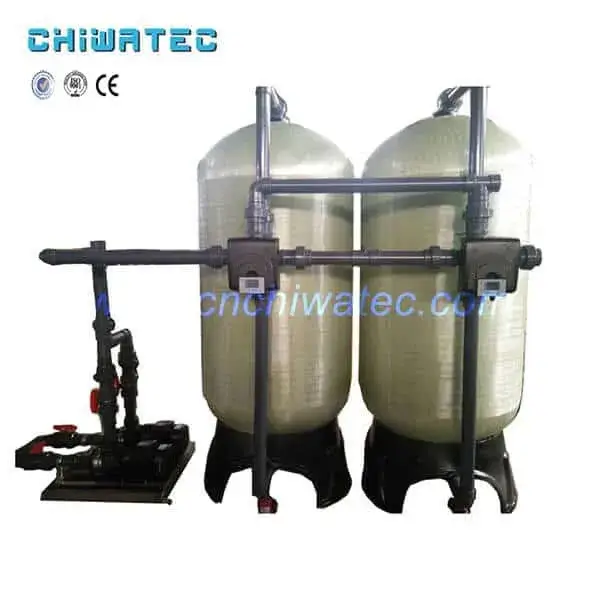
The test at the sampling port of the soft water equipment is qualified, but the water hardness in the soft water tank exceeds the standard. The reasons for this phenomenon are as follows:
- El ciclo de regeneración está configurado demasiado grande o la medición es inexacta debido a la falla del medidor de flujo, por lo que la resina no puede regenerarse a tiempo cuando debería regenerarse, lo que resulta en la inyección de un exceso de agua en el tanque de agua blanda.
- The washing time is too short, so that the waste salt water that should be washed away in the washing is partially brought into the soft water tank.
- Too little water supply to the salt tank, too little salt absorption, and insufficient positive washing caused by unstable water pressure in the water supply, any of which can cause the water hardness to exceed the standard after the regeneration, affecting the water quality of the soft water tank.
- Cuando hay muy poca sal en la caja de sal, no se puede agregar a tiempo, lo que resulta en un efecto de regeneración deficiente.
- Operación incorrecta, cierre la válvula de suministro de agua durante un proceso de regeneración.
Any of the above errors can cause a large amount of excess water to fill the soft water tank in a short time. It takes a long time to dilute the excess water with qualified soft water to make the water in the soft water tank reach the standard again.
The hardness of the newly installed water softening equipment exceeds the standard for the first test and the hardness of the water softening equipment in use exceeds the standard.
Reasons why the hardness of the newly installed water softening equipment exceeds the standard in the initial test:
- La junta tórica en la unión del tubo central y la válvula de control no forma un sello. En este momento, se debe verificar:
- Si la longitud del tubo central es suficiente y si el diámetro exterior cumple con los requisitos
- ¿Olvidaste instalar el sello anular?
- Si la junta tórica está dañada
- Roto y agrietado en el tubo central.
- La relación entre el valor TDS del agua de alimentación y la altura de la capa de resina es demasiado grande.
- La relación entre el valor TDS del agua de alimentación y la capacidad de intercambio de resina es demasiado grande.
- Las conexiones de entrada y salida están invertidas.
Reasons why the hardness of soft water in the water softening equipment exceeds the standard:
- La relación entre el valor TDS del agua de alimentación y la altura de la capa de resina o la capacidad de intercambio de resina es demasiado grande. En comparación con la prueba de agua inicial de la nueva resina, el equipo de ablandamiento de agua tiene requisitos más estrictos sobre el valor de TDS del suministro de agua. Cuando la altura de la capa de resina es de 1,5 metros, la dureza total es de 13mmol/L y el valor TDS del suministro de agua es ≧900mg/L, asegúrese de que la dureza del agua blanda sea ≤0,03 mmol/L será más difícil.
- Resin poisoning, decrease in resin exchange capacity due to aging. The soft water hardness exceeding the standard caused by this reason is a gradual process, not a sudden and obvious exceedance.
- La cantidad de sal en el depósito de sal es demasiado baja. Cuando la cantidad de agua en el tanque de sal es normal y la altura de la sal es inferior a 1/3 de la altura del agua, es probable que la salmuera absorbida en las etapas media y tardía del paso de absorción de sal no esté saturada , de modo que la concentración de salmuera después de la dilución por el eyector es menor que el requisito de regeneración, lo que afecta el efecto de regeneración.
- La cantidad total de agua en el depósito de sal es demasiado pequeña. Nuestra experiencia es que por cada 100L de resina en el tanque de resina, la cantidad requerida de agua en el tanque de sal es de unos 35-40L. Demasiada agua por debajo de este estándar provocará una regeneración insuficiente.
- la solución salina de succión es demasiado lenta, en tiempo normal, no puede absorber suficiente solución salina, las razones son las siguientes:
- La presión del suministro de agua es demasiado baja.
- Los sedimentos y otros desechos en el agua de distribución superior e inferior están seriamente bloqueados
- Drenaje deficiente de las aguas residuales causado por la deformación y la flexión de las mangueras de aguas residuales
- Demasiadas impurezas en la capa de resina
- Hay un punto de fuga en el tubo de aspiración de sal, lo que hace que el aire aspirado
- Foreign matter in the jet
- La válvula de retención de aire falla, se cierra antes o está bloqueada
- La selección del eyector es demasiado pequeña.
There is a large amount of gas in the resin tank, which may come from the gas in the feed water, or the air check valve is not closed tightly during the slow washing process.
- No se utiliza sal no yodada de grano grande.
- Internal leakage of the control valve: When the internal leakage of the general control valve is hard, the soft water outlet and the waste water outlet often come out at the same time, but for the 64D or 74A series, internal leakage may be formed through the small holes on the ceramic moving piece. The internal leakage is in the positive flushing position, and qualified soft water can be detected at the waste water outlet, but when it is transferred to the running position, the hardness of the soft water exceeds the standard. Since the hardness of water is mainly formed and represented by calcium and magnesium, cation exchange resin (water softener) is generally used to replace Ca2+ and Mg2+ (the main components of scale formation) in the water. With the increase of Ca2+ and Mg2+ in the resin, The resin removal efficiency of Ca2+, Mg2+ gradually decreased. After the resin absorbs a certain amount of calcium and magnesium ions, it must be regenerated. The regeneration process is to rinse the resin layer with salt water in the salt tank to replace the hardness ions on the resin. The softening swap function has been restored. Since the hardness of water is mainly formed by calcium and magnesium and indicates that the hardness of water is mainly formed by calcium and magnesium and indicates that the principle of sodium ion exchange softening treatment is to pass the raw water through the sodium cation exchange resin, the hardness components Ca2+, Mg2+ in the water and The Na+ in the resin is exchanged, thereby adsorbing Ca2+ and Mg2+ in the water and softening the water.
Xian CHIWATEC Water Treatment Technology es una empresa de alta tecnología especializada en varios dispositivos de procesamiento de agua. Aparte de estos productos individuales, que cubren una serie de tipos y series, también podemos ayudar con proyectos de ingeniería integrales relacionados. Gracias a nuestro arduo trabajo y dedicación desde nuestra fundación, ahora somos uno de los fabricantes de equipos de tratamiento de agua de más rápido desarrollo en el oeste de China.
Otras lecturas:
SÍGANOS
¿Tiene un proyecto de tratamiento de agua con el que podamos ayudar?
* Diseño, mecanizado, instalación, puesta en marcha, personalización y servicio integral
 Spanish
  English
  Portuguese